
Last updated on June 12, 2026, by Lucy
Custom motorcycle parts can fail if they lack accuracy, consistency, or material strength. Many aftermarket components look good but create fitment, durability, and safety problems.
CNC machining is one of the best manufacturing methods for customized motorcycle parts because it delivers exceptional precision, repeatability, material flexibility, and surface quality. It allows manufacturers to produce high-performance motorcycle components that fit accurately, improve reliability, reduce weight, and maintain consistent quality from prototype development through production.

Motorcycle enthusiasts, electric motorcycle brands, and aftermarket manufacturers all want parts that improve performance, appearance, and reliability. In my experience as a CNC machinist, CNC machining provides the control needed to turn engineering designs into functional motorcycle components that meet demanding real-world conditions.
What Types of Motorcycle Parts Can Be CNC Machined?
Many motorcycle components operate under high loads, vibration, heat, and constant wear. Traditional manufacturing methods may struggle to maintain tight tolerances across complex geometries.
CNC machining can produce a wide range of customized motorcycle parts, including triple clamps, foot pegs, brake calipers, wheel hubs, sprockets, engine covers, handlebar clamps, battery housings, motor mounts, and many other structural or cosmetic components that require high precision, strength, and durability.

Motorcycle manufacturers use CNC machining for both functional and cosmetic components. The process works well for prototypes, racing applications, aftermarket upgrades, and low-volume production.
Common Motorcycle Parts Suitable for CNC Machining
| Component | Typical Material | Purpose |
|---|---|---|
| Triple Clamps | Aluminum 6061/7075 | Steering Stability |
| Foot Pegs | Aluminum, Stainless Steel | Rider Control |
| Brake Calipers | Aluminum 7075 | Braking Performance |
| Wheel Hubs | Aluminum 6061 | Weight Reduction |
| Sprockets | Aluminum, Steel | Power Transmission |
| Engine Covers | Aluminum | Protection and Appearance |
| Handlebar Risers | Aluminum | Ergonomics |
| Battery Housings | Aluminum | Battery Protection |
| Motor Mounts | Aluminum, Steel | Structural Support |
I often see customers begin with a single prototype component. They later expand into complete assemblies once they verify fitment and performance. CNC machining supports this growth because the same CAD model can move directly from prototype to production with minimal design changes.
Why Motorcycle OEMs and Aftermarket Brands Prefer CNC Machining
Motorcycle components often require precise mating surfaces, threaded holes, bearing bores, and complex contours. CNC machining maintains consistency across these critical features.
This becomes especially important for performance motorcycles and electric motorcycles where weight reduction and structural integrity directly affect handling, acceleration, range, and rider safety.
What Materials Are Best for CNC Motorcycle Parts?
Selecting the wrong material can cause premature wear, excess weight, corrosion, or even catastrophic failure. Material choice is often as important as the part design itself.
The best materials for CNC motorcycle parts include aluminum 6061, aluminum 7075, stainless steel, titanium, nylon, and engineering plastics. Material selection should be based on strength requirements, weight targets, wear resistance, corrosion resistance, operating conditions, and project budget.

Over the years, I have machined thousands of motorcycle components. Most projects fall into several material categories.
Material Comparison for CNC Motorcycle Components
| Material | Advantages | Common Applications |
|---|---|---|
| Aluminum 6061 | Lightweight, Economical | Covers, Brackets, Housings |
| Aluminum 7075 | High Strength-to-Weight Ratio | Triple Clamps, Racing Parts |
| Stainless Steel 304 | Corrosion Resistant | Fasteners, Brackets |
| Stainless Steel 316 | Marine Corrosion Resistance | Coastal Applications |
| Titanium Grade 51 | High Strength, Low Weight | Premium Racing Components |
| POM (Delrin) | Low Friction | Bushings, Guides |
| Nylon | Wear Resistance | Non-Structural Components |
Material Selection Factors
I usually recommend evaluating four factors first:
- Mechanical load
- Environmental conditions
- Weight targets
- Budget constraints
A racing motorcycle often prioritizes weight reduction. An adventure motorcycle may prioritize durability. An electric motorcycle may focus on battery enclosure protection and thermal management.
The material decision should support the actual operating environment rather than simply choosing the strongest or most expensive option.
Why CNC Machining Is Ideal for Motorcycle and Electric Motorcycle Components?
Motorcycle and electric motorcycle manufacturers face increasing pressure to reduce development time while maintaining quality. Traditional tooling methods often require significant upfront investment.
CNC machining is ideal for motorcycle and electric motorcycle components because it enables rapid prototyping, tight tolerances, low-volume production, and design flexibility without expensive tooling costs. Manufacturers can validate designs faster, reduce development risk, and move efficiently from prototype testing to production.
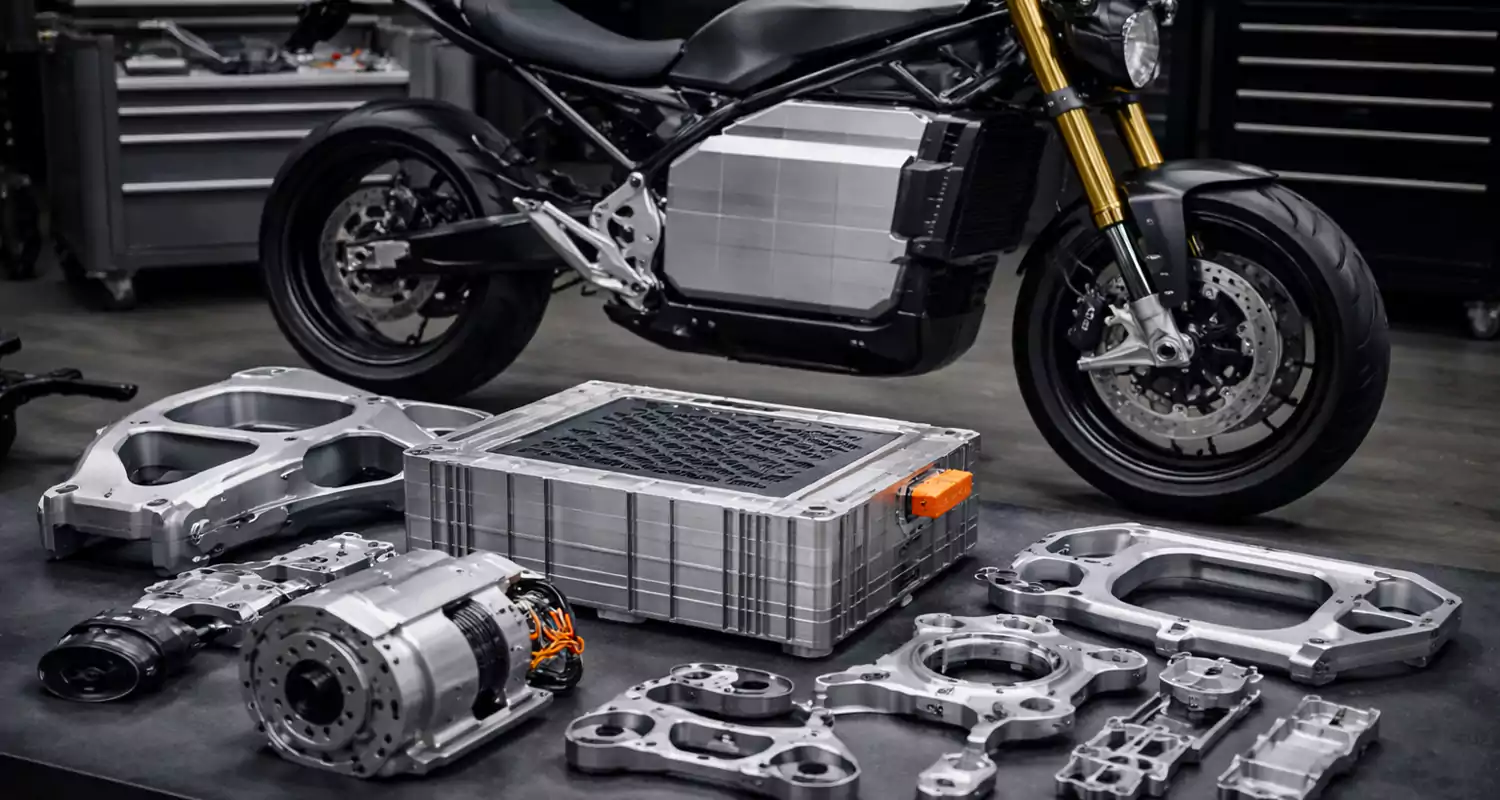
Many manufacturers rely on professional CNC machining services because they provide the flexibility required for rapid prototyping, engineering validation, and low-volume production before scaling to larger quantities.
One project I worked on involved a startup developing electric motorcycles for urban transportation. They needed lightweight battery enclosures and motor mounting brackets before committing to production tooling.
Case Study: Electric Motorcycle Battery Housing Project
The customer required prototype validation before launching production.
| Parameter | Specification |
|---|---|
| Material | Aluminum 6061-T6 |
| Quantity | 120 Sets |
| Tolerance | ±0.03 mm |
| Surface Finish | Black Anodizing |
| Housing Size | 420 × 180 × 95 mm |
| Weight Target | < 2.8 kg |
| Production Time | 18 Days |
| CNC Machines Used | 4-Axis Vertical Machining Centers |
| Inspection Method | CMM Verification |
The original fabricated design weighed 3.4 kg. After redesigning the geometry for CNC machining, the final housing weight dropped to 2.65 kg while maintaining structural requirements.
The customer completed road testing six weeks earlier than expected. That accelerated their product launch schedule and reduced development risk.
Advantages for Electric Motorcycle Manufacturers
Electric motorcycles introduce new design requirements2:
- Battery protection
- Thermal management
- Lightweight structures
- Compact packaging
- Fast design iterations
CNC machining supports all these objectives. Design updates can be implemented immediately through CAD revisions without creating new molds or dies.
Precision, Surface Finishes, and Cost Considerations?
A motorcycle part must do more than simply fit. It must perform consistently under real operating conditions while maintaining visual appeal.
CNC machining provides excellent dimensional accuracy, a wide range of surface finish options, and scalable production capabilities. Costs are primarily influenced by material choice, part complexity, machining time, surface treatments, inspection requirements, and production volume.

Precision plays a major role in motorcycle performance. Poorly machined mounting points can create alignment issues. Inaccurate bearing bores can reduce component life.3
Typical CNC Machining Capabilities
| Feature | Typical Capability |
|---|---|
| General Tolerance | ±0.05 mm |
| Precision Tolerance | ±0.01 mm |
| Surface Roughness | Ra 0.8–3.2 μm |
| Thread Accuracy | High Repeatability |
| Complex Geometry | Excellent |
Popular Surface Finishes
Motorcycle customers often choose finishes that improve both durability and appearance.
| Finish | Benefits |
|---|---|
| Anodizing | Corrosion Resistance |
| Powder Coating | Durable Color Finish |
| Bead Blasting | Uniform Matte Appearance |
| Polishing | Premium Appearance |
| Electropolishing | Improved Corrosion Resistance |
The largest cost drivers usually include:
- Raw material cost
- Machining time
- Tool wear
- Surface treatment
- Inspection requirements
Good design practices can often reduce machining costs without affecting performance.
How to Choose a CNC Machining Supplier for Customized Motorcycle Parts?
A poor supplier can create delays, quality problems, and expensive redesigns. Selecting the right manufacturing partner is often as important as selecting the right design.
The best CNC machining supplier for customized motorcycle parts should demonstrate technical expertise, strong quality control, material knowledge, production flexibility, and proven experience manufacturing high-precision components for demanding motorcycle applications.

When evaluating a supplier, I recommend looking beyond machine count and pricing.
Key Evaluation Criteria
| Factor | Why It Matters |
|---|---|
| Engineering Support | Design Optimization |
| CNC Equipment | Capability and Efficiency |
| Quality Control | Consistent Part Accuracy |
| Material Traceability | Compliance and Reliability |
| Surface Finishing Options | One-Stop Manufacturing |
| Lead Time Performance | Project Scheduling |
| Communication | Faster Issue Resolution |
Questions to Ask Before Ordering
- Can the supplier achieve required tolerances?
- Do they provide DFM feedback?
- Can they support prototype and production quantities?
- Do they offer inspection reports?
- Can they handle finishing processes in-house?
- Do they protect confidential CAD files?
I have found that long-term manufacturing success comes from working with suppliers who understand both machining and application requirements. The best suppliers act as engineering partners rather than simple part producers.
Conclusion
Customized motorcycle parts require more than creative designs. They depend on precise manufacturing, suitable materials, and consistent quality to perform safely and reliably. CNC machining brings all of these factors together, making it the preferred solution for producing high-performance motorcycle and electric motorcycle components from prototype development through full-scale production.
Footnotes:
-
"Ti-6Al-4V - Wikipedia", https://en.wikipedia.org/wiki/Ti-6Al-4V. A neutral materials source can support that Ti-6Al-4V, commonly called Titanium Grade 5, combines high specific strength with relatively low density and is widely used in demanding aerospace and engineering applications; this is contextual support for its use in premium racing motorcycle components. Evidence role: general_support; source type: education. Supports: Titanium Grade 5 provides high strength at low weight, making it relevant for premium racing components.. Scope note: The evidence would establish material properties and analogous high-performance uses, not direct evidence that it is optimal for all racing motorcycle components. ↩
-
"Battery Pack Thermal Design (Conference) | OSTI.GOV", https://www.osti.gov/biblio/1304580. A peer-reviewed review of electric-vehicle battery-pack or powertrain design discussing safety protection, thermal management, packaging constraints, and weight reduction would substantiate these as common design requirements; if the source focuses on electric vehicles generally, its support for motorcycles is by technical analogy rather than direct evidence. Evidence role: expert_consensus; source type: paper. Supports: Electric motorcycles introduce design requirements such as battery protection, thermal management, lightweight structures, compact packaging, and fast design iterations.. Scope note: The best neutral sources may discuss electric vehicles broadly rather than electric motorcycles specifically. ↩
-
"[PDF] Rolling Bearing Life Prediction, Theory, and Application", https://ntrs.nasa.gov/api/citations/20160013905/downloads/20160013905.pdf. Research on rolling-element bearings shows that fit errors, geometric inaccuracies, and misalignment can change load distribution and reduce bearing fatigue life, supporting the claim that inaccurate bearing bores may shorten component service life. Evidence role: mechanism; source type: paper. Supports: Inaccurate bearing bores can reduce component life.. Scope note: The evidence is typically based on bearing systems in general rather than motorcycle-specific assemblies. ↩